
The term scattered generally refers to objects, thoughts, or people dispersed unevenly across an area.
For example: leaves scattered on a forest floor, or a scattered mental state characterized by unfocused thoughts.
In the context of displacement, scattered also captures the dispersed and fragmented nature of movement and settlement. Climate migrants are often scattered across regions, rather than settling in concentrated groups, impacting resources, data collection, policy responses, and even the integrity of communities left behind.
After the challenging process of “Unsettled,” Devora’s artifact for “Scattered” felt much easier to take in.
First, it involves a legal document: something as a lawyer I’m fairly comfortable with. Second, it carries a hint of humor that I can appreciate.
Video credit:Izadora Reis; Editing credit:Devora NeumarkThe video begins with Devora copying sections from the Platform on Disaster Displacement (PDD) Strategy 2019-2023 into a red notebook. This document probably holds particular relevance for Devora, given their studies as a Climate Change Adaptation Practitioner through the Yale School of Public Health and in Emergency Management at Wilfrid Laurier University.
Despite its significance in the field of climate-induced migration, my impression is that this text remains largely unfamiliar outside specialized circles. Some context might clarify its relevance.
The PDD emerged as a follow-up to the Nansen Initiative, a pioneering effort launched in 2012 by Switzerland and Norway to address cross-border displacement triggered by climate and disaster events. Named after Fridtjof Nansen, the first High Commissioner for Refugees, the Nansen Initiative established foundational principles on protecting people who migrate due to environmental crises. The initiative brought together over 100 countries and was instrumental in shaping global awareness of climate-driven displacement.
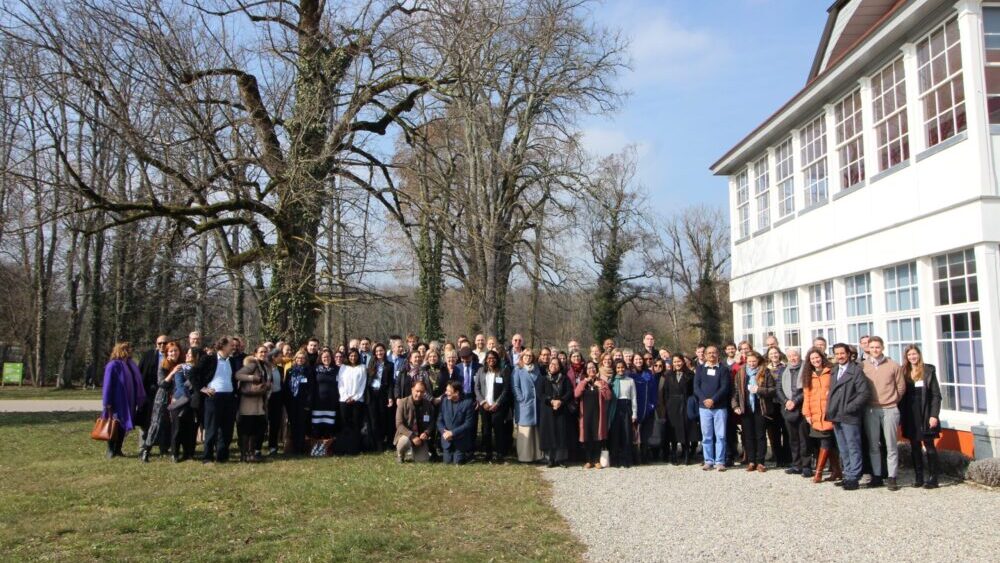
The Nansen Initiative’s legacy was cemented in 2016 with the formation of the PDD, which took on the responsibility of advancing the Protection Agenda created by the Nansen Initiative. The PDD stands out as a collaborative effort, led by a rotating Steering Group of 15-20 countries and the European Union, alongside an open-ended “Group of Friends” of supporting nations. Rather than calling for new treaties, the PDD focuses on enhancing protection within existing frameworks, often working at national and regional levels to integrate effective practices into policies that aid displaced individuals across borders.
The PDD Strategy represents a formal, state-led response to climate displacement. In the video, Devora performs a personal gesture by copying sections of the text, bridging the impersonal tone of this structured document with an embodied response. By writing it in their own hand, they add a personal interpretation to this complex, policy-driven text.
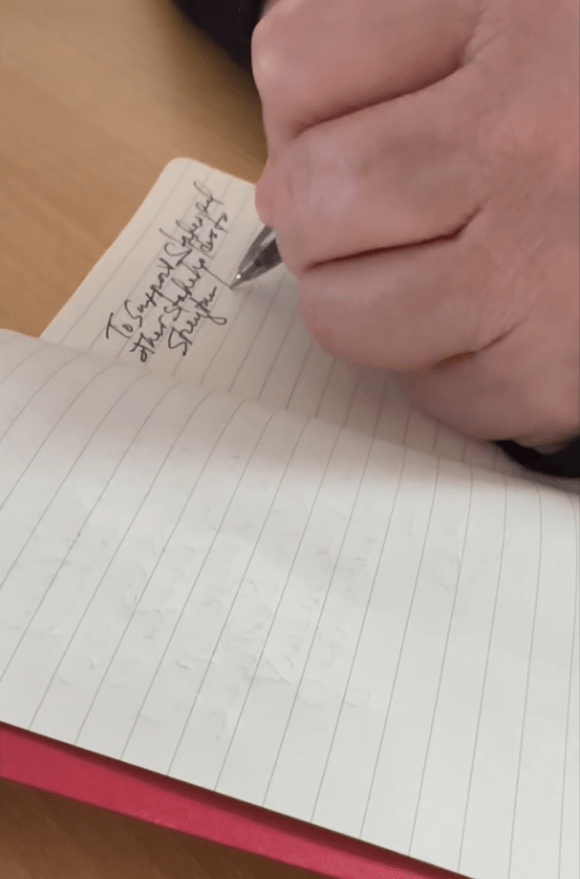
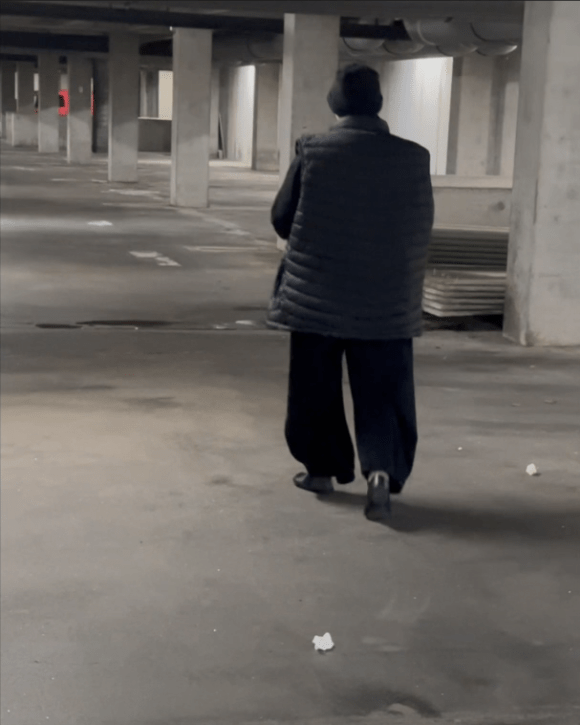
Scattered, Devora Neumark, 2024After accelerated images of filling a red notebook with transcriptions, the video shows Devora in a nearly empty parking garage, scattering torn pages from the notebook. At the end, a parked red car is visible – a visual echo of the red notebook, symbolizing the transition from an instrument of writing to one of movement.
The choice of the parking garage has its significance. Devora writes:
“I picked the parking garage as the location for the performance because it’s such a stark symbol of the ever-present and pervasive economic pull toward fossil fuels. Oil and gas interests still overpower the critical need to invest in renewable energy, and I was hoping that by choosing this location, the performance would highlight how these misplaced economic priorities directly contribute to displacement. The scattered pages on the concrete almost reflect back our dependency on fossil fuels in this echo chamber of a parking lot, critiquing the entire structure that keeps us locked into this cycle.”
For Devora, that red car is also a reference to the individualism and car culture that props up fossil fuel reliance.
Scattered, Devora Neumark, 2024They write:
“The car itself is utilitarian, sure, but in this setting, it becomes a symbol of how deeply ingrained these dependencies are in our economies and lives—another nod to our failure to shift toward sustainable alternatives. The car is just sitting there, parked, reinforcing the inaction that’s plaguing real climate action.”
The red notebook itself is a powerful symbol, echoing various cultural meanings associated with “red books”: government reports, legal texts, or significant literary works. For instance, in British contexts, official government reports bound in red have long been symbols of authority, while The Red Book by Carl Jung represents deep self-reflection and exploration, and Mao Zedong’s Little Red Book symbolizes ideological commitment.
Through the ritual of tearing and scattering pages, Devora’s performance transforms a dense policy document into rubbish.
It’s worth noting that the copied document is somewhat outdated, being the 2019-2023 strategy, even though much of it remains unimplemented. What does one do with an expired international policy strategy? Is it to be treated like a forgotten yogurt, left in the fridge eleven months past its “best before” date?
PDD Advisory Committee photo: https://disasterdisplacement.org/about-us/In truth, the PDD Strategy is a rather difficult text to understand and absorb. It is not directed toward displaced individuals themselves; instead, it’s written in language that’s hard to decode – those infamous “codes.”
It references documents like the New York Declaration for Refugees and Migrants, the Global Compact for Migration and the Global Compact on Refugees; the Sendai Framework for Disaster Risk Reduction 2015-2030; and the UN Framework Convention on Climate Change. It assumes readers are familiar with these documents and their content, can understand the references, and know how to connect their ideas and grasp their significance.
Who can fully grasp phrases like, “Support integrated implementation of global policy frameworks on human mobility, climate change action, and disaster risk reduction relevant for disaster-displaced persons” or “Promote policy and normative development to address gaps in the protection of persons at risk of displacement or displaced across borders”?
Such language adds yet another layer of distance from those it’s meant to support.

PDD "Group of Friends" photo: https://disasterdisplacement.org/about-us/group-of-friends/Devora writes:
“By scattering the pages that I had meticulously scribed earlier, I wanted to show the inaccessibility of policy language when it’s separated from real-world application. An empty parking garage is hardly a place for these pages to influence or educate anyone—it becomes a bit of a metaphor for how disconnected these policy discussions can be from what’s happening on the ground. It underscores just how impotent these documents are when they’re divorced from the people they’re actually meant to support.”
The language of international policy operates indeed within its own codes. While these policies aim to influence what happens on the ground, the vocabulary differs greatly from what frontline services would use.
What, then, is the symbolism of scattering this text? Is it an act of propagation or a way of underscoring its limited usefulness when separated from its full context?
For Devora, the scattering is also symbolic:
“Responsibility for addressing climate displacement is so scattered across nations, organizations, and sectors that no single entity is ever really held accountable. By tearing up and scattering the copied PDD excerpts, I was aiming to reflect how accountability is just as dispersed, often falling through the cracks with no one to answer for it.”
While reflecting on these ideas this week, I attended a presentation and performance on medieval music, performed from ancient manuscripts. These manuscripts are challenging to interpret, first because musical notation has evolved over time. For instance, unlike the five-line staff used today, the four-line staff was common in the Middle Ages. Additionally, they often assume the reader is familiar with certain pieces. For example, one song might end with a note directing the performer to another well-known piece, without providing the transcription. Like policy texts, these manuscripts are coded, filled with symbols and references that require context to be understood, assuming an insider’s knowledge and making them difficult to access without guidance.
Adding to the complexity, many of these manuscripts have been separated over time, scattered across the world one page at a time, reminding me of Devora’s performance. This dispersal has left pieces of the original context missing or incomplete.
Both medieval manuscripts and a hand-copied policy text, in their fragmented forms, become even harder to interpret, symbolizing the challenge of piecing together meaning from scattered elements.

Detail of a manuscript: https://www.mcgill.ca/library/channels/event/exhibit-chant-alive-exhibit-mounted-collaboration-mcgill-schulich-school-music-and-montreals-360375One of the manuscripts discussed at the lecture id known as Manuscript 73 at McGill University. It is a choir book containing parts of the Divine Office, or canonical hours, that are sung. It includes chants for specific feasts and liturgical occasions, such as those honoring Saint Ursula.
In an interesting parallel, Saint Ursula can be seen as a symbol of displacement. According to legend, Ursula, a 4th-century Romano-British princess, left her homeland on a pilgrimage across Europe, accompanied by handmaidens. Ultimately, their journey ends in martyrdom: beheaded at the hands of the Huns in Cologne. Her story over time, became a cultural symbol of courage, faith, and exile.

Hans Memling,The Martyrdom of Saint UrsulaOne interesting aspect of codes is how the number of Ursula’s companions went from 11 to 11,000. One theory suggests this was due to the letter M (for martyrs) being mistaken for the Roman numeral 1,000, vastly multiplying her followers. Perhaps this is a medieval form of “fake news.” Or perhaps it serves as a reminder of the challenges in gathering reliable data on displaced populations, especially those who do not survive their journey.
Another fascinating element of these musical manuscripts is the effort to reconstruct and interpret them back into music, the way it was originally meant to be sung.
Moving from scattered to organized. Finding coherence and meaning. Making sense.
For example, one expert at the conference noted that plainchant often sounds monotonous because modern interpretations may misread the rhythm, when, in fact, these pieces may contain more movement.
I imagine that, after the performance, Devora—likely mindful of laws against littering and environmental impact—gathered the scattered pages. But what if they hadn’t? Is it possible someone else could have found them and tried to make sense of them? Likely, they wouldn’t succeed.
Yet on a more abstract level, experts are constantly working to piece together and implement these policy recommendations. But how effectively do these efforts move from ideas on policy pages to real-world impact? Are these efforts organized, or do they remain as scattered as the torn pages? Devora writes:
“Unfortunately, I’m more inclined to believe that it reflects the piecemeal way that organizations and policymakers are trying (and more often than not failing) to piece together effective climate policies.”
This whole project is, at its core, about interpreting and weaving coherence from scattered elements: photos, videos, gestures, and texts from Devora. It’s a process of moving through layers of complexity to uncover meaning.
The act of scattering papers on the barren ground of a parking lot evokes another image: seeds cast onto fertile soil.
In the same way, Displacement Codes gathers fragments of contemplative acts, scattering seeds (or acorns) that invite others to pause, reflect, and, ultimately, to act.
This project is also about dialogue, and while my vision of planting seeds was hopeful, Devora described this as their least hopeful performance yet, evoking the image of “casting empty promises to the wind.”
Still, my response to their artifact reframed this unhopefulness a bit. They wrote:
“Your insights into the process of interpreting and organizing medieval manuscripts offered me a glimmer of hope, actually. Just as ancient music has to be reconstructed with purpose and devotion, maybe there’s a path forward in climate displacement policy too? Maybe the act of piecing together and performing these policies with intention can make a difference.”
What does this performance and its interpretation evoke for you? Are your thoughts scattered or orderly?
*This article was edited with the assistance of Perplexity and ChatGPT



 Displacement Codes - Contemplative Performance and the Climate Crisis
Leave a comment