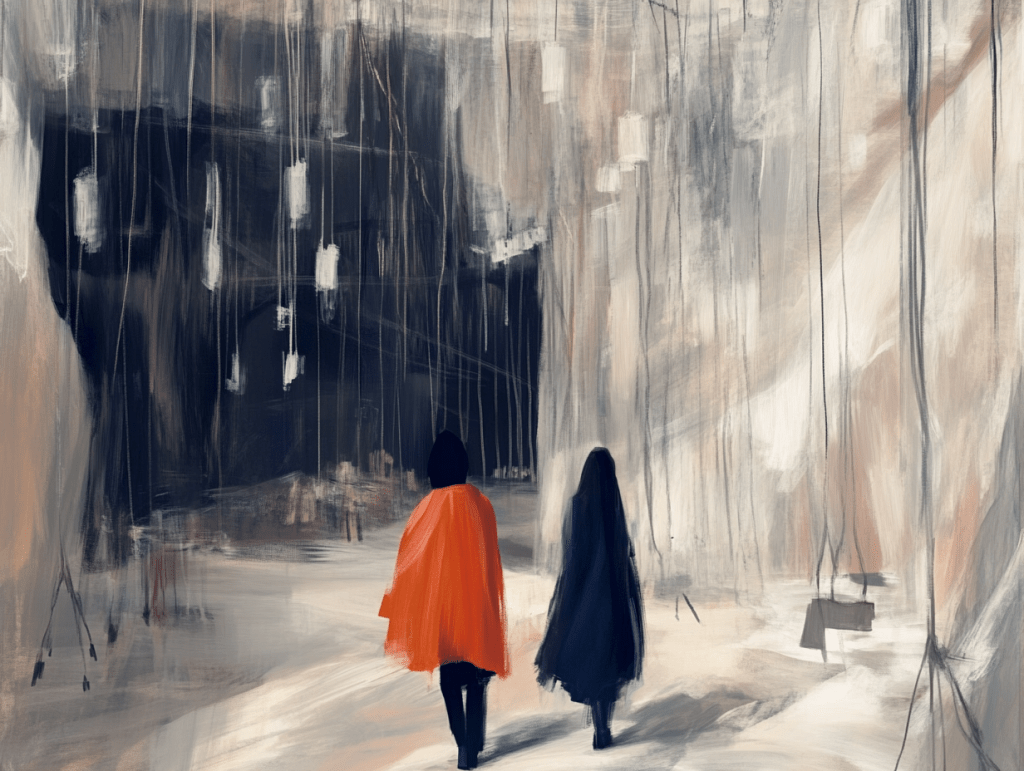
Image generated with Midjourney, prompt : "Illustrate Displacement Codes-Contemplative Performance and the Climate Crisis. Answer questions: What are we talking about and what does is all mean?"(variation, modified)My first post in this project led me to a question emerging from Devora’s performance practice: “What does is all mean?” It was about a reflection before the action.
In legal texts, definitions often come first. Many legal documents begin with a section dedicated to definitions, ensuring there’s no confusion, especially if conflict arises – that we know precisely what we are talking about.
Legal writing isn’t particularly creative, and synonyms are unwelcome. Some might argue that true synonyms don’t exist. Most legal field practitioners would agree. You choose a word, define it, and use it consistently.
What prompted all this
The need to define our terms became clear from the very beginning of our project.
This collaboration started with a text message from Devora that began with, “I just had what may be a crazy idea but actually might be quite brilliant…” They suggested integrating AI and prompts into a project focused on the climate crisis and displacement. I said yes right away!
The thing is, I thought I knew what a prompt was, and so did Devora. But as it turned out, we were each talking about two very different things.
As the conversation evolved following my expressed interest in collaborating on AI-related projects, it shaped my understanding of the word “prompt.” In the world of AI, a prompt is a piece of natural language text that serves as an input – a cue or instruction that initiates a specific action or response from the AI. It defines the task the AI should undertake, whether in the form of a question, command, or statement, providing the context needed to guide the AI in generating relevant “outputs”.
For Devora, however, a “prompt” has a different meaning. In performance art, a prompt serves as a starting point or inspiration for a gesture or artistic creation, much like a “performance score.” This score is a set of instructions or ideas that guide the artistic process, leaving room for interpretation and adaptation across time and space. Devora’s use of prompts is rooted in a tradition of performance art influenced by Fluxus and artists like Yoko Ono. They explained this approach allow performances to evolve, be re-created, and open up spaces for participation and social engagement.
While AI prompts drive the creation of specific outputs, Devora’s prompts are designed to provoke reflection, dialogue, and multiple interpretations, fostering a deeper connection between the artist and the audience. What I saw as a functional tool, Devora saw as a vehicle for exploration.
We virtually shook hands on a contract, even though our understandings were leading us to different directions.
We were using the same words but discussing very different concepts, a qui pro quo amplified by the nature of communicating through email and text, which often stripped away nuances. This left us to fill in the gaps with our own assumptions.
This experience made me realize that this entire project wasn’t immune to misunderstandings. Devora would be sending me artifacts that I would need to interpret, and our dialogue would unfold from vastly different perspectives, experiences, and vocabularies.
As mentioned previously, while Devora is very comfortable with the incongruity that a performance might bring, leaving ample room for interpretation and discussion. I came to the conclusion that I need clear boundaries that define my thinking and perception. To reach the point of asking “what does it all mean?”, I first need to understand “what are we talking about?”
I realized that while Devora often “makes meaning,” I try to “make sense.” I frequently ask why a particular word is being used.
This need for clarity makes me pause at each word in our project’s title—to analyze, interpret, and discuss its significance.
I won’t define Contemplative Performance, as I believe the previous article covered that in depth. But I do want to explore Displacement, Codes, and the Climate Crisis.
Displacement
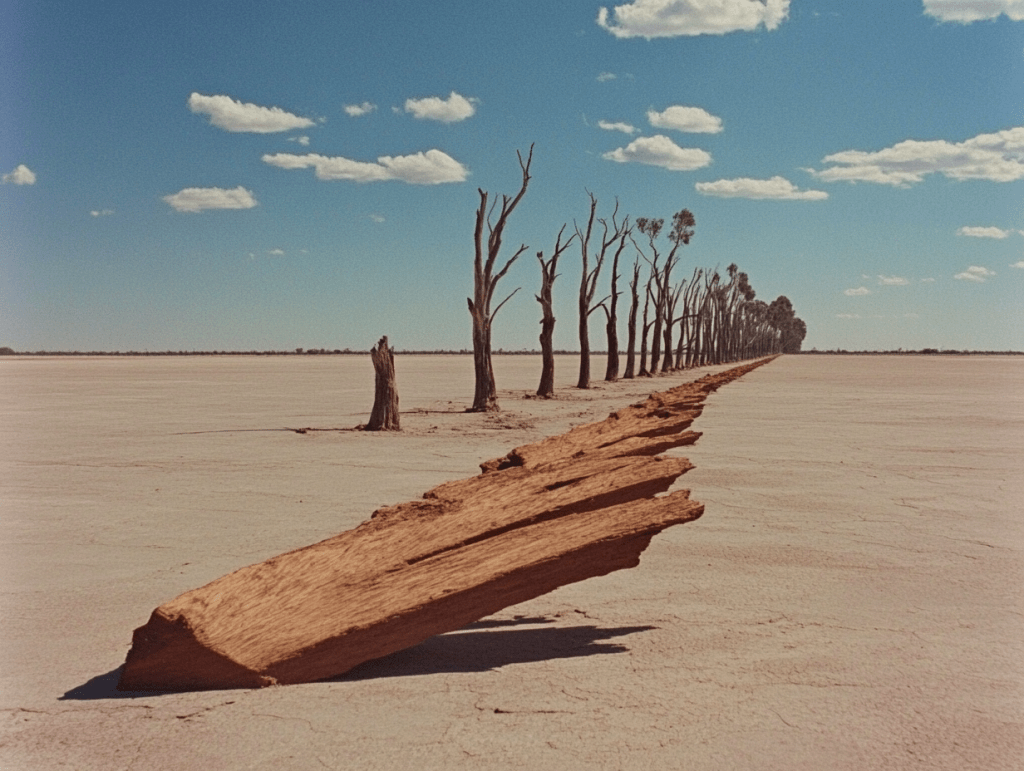
Image generated with Midjourney, prompt:"Displacement Codes-Contemplative Performance and the Climate Crisis What are we talking about and what does is all mean?"Displacement is the first word of the title and at the heart of this project.
Cambridge dictionary defines displacement as a “the situation in which people are forced to leave the place where they normally live”.
While we are talking of displacements, we are of course thinking of the displaced. Who exactly are these people? Why speak of the displaced and not the migrants or refugees?
Many words are frequently used around the displaced.
Migrant, for example, is not a legal term. According to the United Nations’ International Organization for Migration (IOM), it refers to “any person who has resided away from his or her place of usual residence, whether within a country or across an international border, regardless of the person’s legal status; whether the movement is involuntary or voluntary; what the causes for the movement are; or what the length of the stay is.”
The word refugee however refers to a specific legal text: the 1951 Geneva Convention. It defines “any person who, owing to a well‐founded fear of persecution for reasons of race, religion, nationality, membership of a particular social group or political opinion, is outside the country of his or her nationality… and is unable or, owing to such fear, is unwilling to return to it.”
The International Organization for Migration’s Glossary on Migration, also defines an asylum seeker as “[a]n individual who is seeking international protection.” More precisely: “In countries with individualized procedures, an asylum seeker is someone whose claim has not yet been finally decided on by the country in which he or she has submitted it. Not every asylum seeker will ultimately be recognized as a refugee, but every recognized refugee is initially an asylum seeker.”
All of these individuals have been “displaced.” In political discourse, these terms often blend together, masking a deeper sentiment—the unspoken label of “stranger”. It’s not just that these people leave behind homes that are familiar to them; they are entering spaces that others already call home, and for some, the arrival of newcomers makes those spaces feel less “familiar”.
“What does it even mean to be French/German/Italian today?” one might ask. “I can’t recognize this place anymore!” another might say. Too often, the focus is on the experience of those “welcoming” the displaced, overshadowing the voices of those who have been uprooted. Fear takes over compassion.
But displacement doesn’t always involve crossing international borders. It also includes internal displacement: when people are forced or obliged to leave their homes but remain within their own country.
According to UNHCR projections for 2024, there will be 130.8 million displaced people worldwide, with 48% of them being internally displaced persons.
Additionally, an annual average of 21.5 million people were forcibly displaced by sudden onset, weather-related hazards—such as floods, storms, wildfires, and extreme temperatures—each year since 2008. Thousands more are forced to leave their homes due to slow-onset hazards, like droughts or coastal erosion linked to rising sea levels.
The Global Compact on Refugees (GCR) that was adopted by the UN General Assembly on 17 December 2018 acknowledges and addresses the reality of increasing displacement in the context of disasters, environmental degradation and climate change.
Climate change is also identified as a “threat multiplier” in many of today’s conflicts, from Darfur to Somalia, Iraq, and Syria. As UNHCR notes, “The Arab Spring is commonly seen as leading to Syria’s conflict, but people tend to forget the five-year drought in Syria’s northeast that preceded the war and the displacement of some 1.5 million people.” Climate change not only contributes to conflict but also exacerbates displacement when it occurs.
In this project, we focus on those who have been displaced involuntarily, particularly due to changes in their homes caused by the impacts of climate change.
We imagined illustrating different stages of this displacement: what displaced individuals go through, how they experience it, and the emotions they navigate. We strive to explore what this displacement means for them, their communities, and for the rest of humanity, as well as the planet itself.
What is left behind? What is brought along? What is too heavy to carry? What is too difficult to hold onto throughout the journey? Beyond material possessions, it is language, culture, knowledge of a specific land, and the management of resources that are being lost-too often without being documented.
For example, experts note that while speakers of minority languages have already faced a long history of persecution, leading to the extinction of half of all Indigenous languages in Australia, the US, South Africa, and Argentina by the 1920s, today, the climate crisis might be the “final nail in the coffin”. The consequences of climate change displacements might cause many Indigenous languages to disappear, along with the traditions, unique perspectives, and invaluable knowledge they hold.
Codes

Image generated with Midjourney, prompt: "Displacement Codes-Contemplative Performance and the Climate Crisis"The word code has so many meanings, I hardly know where to start!
Its Latin origins trace back to caudex, meaning “the stock or stem of a tree, a board or tablet of wood smeared over with wax, on which the ancients originally wrote; hence, a book, a writing.”
In many legal systems, bodies of law are organized into codes : Civil Code, Criminal Code, Code of Procedures, Code of Professions, and so on. In the imagination of many, practicing law means memorizing these codes and reciting them like magic formulas. On popular TV shows, brilliant lawyers always seem to solve problems by citing obscure laws that no one else remembers. But law codes are not spell books; they are sets of rules, organized by theme, that apply to a specific place and time. These rules are meant to regulate everyone’s lives, yet few people are truly informed about them. Nul n’est censé ignorer la loi – ignorance of the law is no excuse. Still, people choose which laws they pay attention to and which they ignore.
When it comes to laws concerning migrants: a lot of people seem to know what makes someone’s presence in a different country “illegal”. Yet, few can explain which specific laws they are referring to in making this statement. Are these codes local, national or international?
Codes that regulate our lives aren’t however always written. Often, codes of behaviours are implicit and vary between groups, yet failing to follow them can lead to harsh judgment. For displaced people, even in their own country, these unspoken rules are often inaccessible or difficult to understand, putting them at a disadvantage. “You’re clearly not from here” is a common reaction when someone unknowingly breaks a code. Maybe you smile too much, speak too loudly, or ask a question you’re expected to know the answer to. You don’t always realize when you’re breaking a code.
Codes can also be secret. A word might mean something entirely different, while a number or symbol can represent a letter or a concept. These codes are designed to be understood only by a select group, not to be easily decoded.
During World War II, code talkers were military personnel who used Indigenous languages to transmit secret messages, creating codes that were difficult to decipher. In the United States, about 400 to 500 Native Americans, particularly in the Marine Corps, used their languages to send encrypted communications that were never broken, contributing to key victories. Similarly, the Canadian Armed Forces employed Cree-speaking First Nations soldiers as code talkers, though their contributions remained long classified and unacknowledged.
First, this connects to the earlier discussion about how Indigenous languages are at risk due to climate change, highlighting the unforeseen losses for all of humanity. Second, it reminds us that what is a native language to one person can be an unbreakable code to another. The further removed you are from a language, a culture, an experience, or a geographic area, the more challenging it is to decode what is being communicated. In displacement, countless codes without keys to decipher them become additional barriers.
Actually, during their first days in Germany for their fellowship connected to this project, Devora tried to buy a bus ticket and decipher the local transit system. The person at the counter scolded them (in German) for not speaking German and refused to sell them a ticket. Of course, Devora is a well-travelled multilingual academic with many resources to draw upon. But how would someone else respond to such a “warm welcome”?
For computers, a code is a set of instructions, a system of rules written in a specific language that tells the machine what to do. In a similar way, we often say that humans are also programmed by more or less implicit codes. Some thoughts we believe are our own have been passed down to us through generations. On occasion, even the emotions we think we experience independently (shame, fear, disgust) have been programmed into us over time, inherited from our cultures, religions, family histories.
Artificial intelligence works slightly differently from traditional programming. Instead of being explicitly programmed to perform a specific task, AI systems are trained on large datasets, enabling them to learn patterns and make predictions or decisions based on that data. Much like humans, they interpret the information they are given to reach conclusions. But are these conclusions truly their own? They are heavily influenced by the data they’ve been exposed to, making their outputs dependent on the quality and nature of that data.
This reflection on codes raises more questions than it answers. What codes do we take for granted? Which ones do we fail to interpret? How much information is lost between what we communicate and what is received, simply because we are unaware that we are speaking in codes? And how are our behaviours, decisions, and experiences of life shaped by the codes that have programmed us?
For this project, I will need to decode Devora’s performance – even though our programming differs in many ways. Some of my interpretations might fall short, and mine won’t be any more interesting, relevant, or accurate than yours. In fact, your decoding, both individually and collectively, is what matters most in this project, what will have most impact.
Climate Crisis

Image generated with Midjourney, prompt: "Displacement Codes-Contemplative Performance and the Climate Crisis What are we talking about and what does is all mean?"The vocabulary around how humans are impacting our planet has evolved over the decades.
Recently, I attended a conference where a student, likely in her early twenties, came to the microphone with a question about climate change and shared her “discovery”: “Climate talks aren’t new!” She mentioned that she even found references to it in an “old” book from the 1990s.
Those of us who were already born by the end of the last century might remember conversations from a distant past focused on “global warming”: the rise in global temperatures due mainly to the increasing concentrations of greenhouse gases in the atmosphere. We were shown images of cities being swallowed by rising tides: events that seemed as far off in the future as making a video call from a device held in your palm or interacting with talking robots.
We were also preoccupied with energy efficiency, debating the best and worst ways to power our comforts. We were told to turn off the lights when leaving a room.
Then came the term climate change, referring to long-term shifts in temperatures and weather patterns, including changes in precipitation and wind. While these shifts can occur naturally, due to changes in the sun’s activity or large volcanic eruptions, since the 1800s, human activities, particularly the burning of fossil fuels like coal, oil, and gas, have become the primary drivers of climate change.
We were inundated with images of melting glaciers and starving polar bears. These weren’t imaginary anymore: they were real.
But “warming” and “change” are merely descriptive. They explain what is happening to the climate but not what is happening to humans.
For many of us around the world, our lives might feel increasingly detached from the climate. Our homes, workplaces, and entertainment venues have controlled temperatures. “Nature” becomes a weekend destination, not our habitat. Yet, from time to time, floods, hurricanes, and wildfires remind us that we don’t control our environment, but it holds power over us.
And this is where the “crisis” comes in. The planet can continue orbiting the sun for a long time: it is a solid presence in space. But we are fragile creatures, easily endangered by elements beyond our control.
Devora mentioned that “climate crisis” was also the preferred term used by the Inuit youth working on their project, Letters to the Ice.
As the intelligent beings we believe ourselves to be, we think we can overcome this crisis by developing new technology. And if we can’t solve it ourselves, surely the superior intelligence of AI will provide the answers! (Just like we replaced incandescent bulbs with LEDs that use 90% less energy and last up to 25 times longer.)
However, research seems to indicate that for now, our use of AI seems to be worsening the issue rather than improving it.
For example, using generative AI to answer a question consumes up to 30 times more energy than a traditional search engine. And let’s be honest: the majority questions people ask AI don’t deal with solving humanity’s most pressing problems!
Another research estimates that by 2027, AI servers could consume as much electricity annually as the whole country Argentina—about 0.5% of the world’s total electricity use. The paper also suggests that if Google were to transition its entire search business to AI, it would nearly double its energy consumption, reaching levels similar to Ireland’s annual usage.
Generating an image with ChatGPT uses as much energy as charging a smartphone and between 17 to 50 queries using generative AI consume 500 mL of water.
AI development is also putting tech giant’s climate goals in peril as the rapid growth of artificial intelligence is driving new demand for cloud computing infrastructure. Companies like Amazon and Microsoft are investing billions of dollars each year into the construction of data centers that gobble massive amounts of energy.
Moreover, AI can contribute to spreading misinformation around climate change.
When we consider the butterfly effect, the displacement caused by climate change isn’t so far removed from ChatGPT being used to write a term paper or create a deep fake video of a politician.
This leads me to ask a difficult question: is using generative AI as part of this project helpful or harmful?
When AI generates prompts about displacement and the climate crisis, is it guiding us in the right direction, or is our use of AI merely contributing to the very issues we are trying to highlight?
Ultimately, Displacement Codes also force us to confront the contradictions between the tools we use and the problems we seek to solve.
Conclusion
Perhaps defining “what are we talking about” and “how to we make sense of all that” and “what does this all mean” aren’t questions that can be answered at the beginning of the project.
Certainly, each performance will bring us closer to understanding, making more sense, and finding deeper meaning in what this is all about.
Understanding doesn’t mean agreeing. Today, in disagreements, we often urge others to be better informed: “do your own research!”. This implies that the real issue is one of knowledge or understanding. Social media amplifies this divide, creating echo chambers that separate us into groups: those who are right, like us, and those who are wrong.
Yet, it’s in the diversity of viewpoints, where each person offers their own keys to the codes, that we might glimpse a broader, more complete image of humanity and envision a more inclusive future.
There won’t be one true meaning or response to the different steps of this project. What matters most is the contemplation each person brings to the performance.

Image generated with Midjourney, prompt: "different meaning of codes, in the context of displacement, climate crisis and AI"*This text has been written by a human. AI (ChatGPT-4o) has been used to edit some parts of the text. AI (Perplexity) was also used to research sources related to AI energy usage, particularly comparing the energy consumption of using AI tools versus traditional search engines like Google.





Leave a Reply