
“Bound to Earth” is the first stop marking the beginning of this journey, a dual journey. On one hand, it represents the journey of collaboration between Devora and me in this project. On the other, it’s the imagined journey we structured with the order of prompts, tracing the path of a displaced person as they navigate through different stages and challenges. It’s a story we aim to explore, dissect, and follow, letting ourselves be carried by it.
I eagerly awaited the first artifact in my inbox. The theme and our prior exchanges had prepared me for something representing attachment to a land that is home. I imagined hands grasping tangled roots, bare feet buried in the sand, arms wrapped around a tree with fingers caked in dirt, or gardening tools sinking into arid soil.
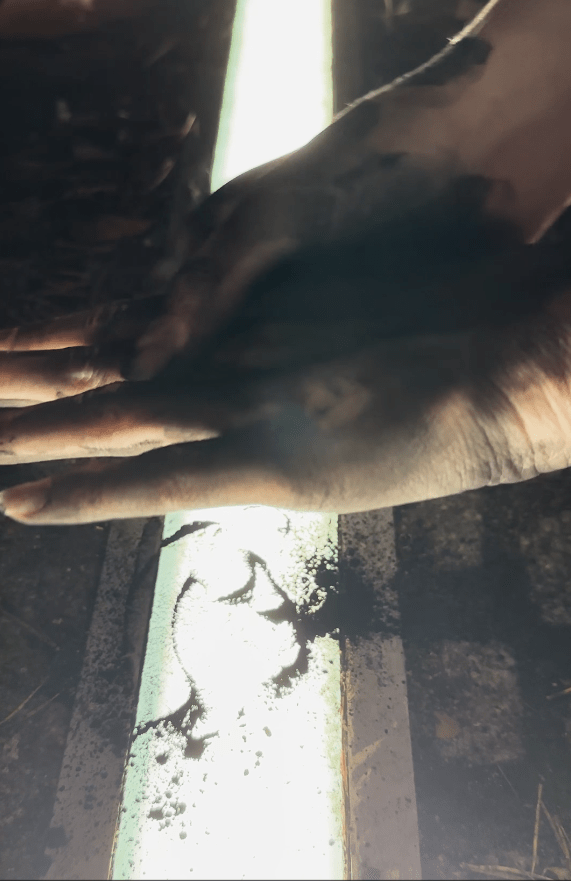
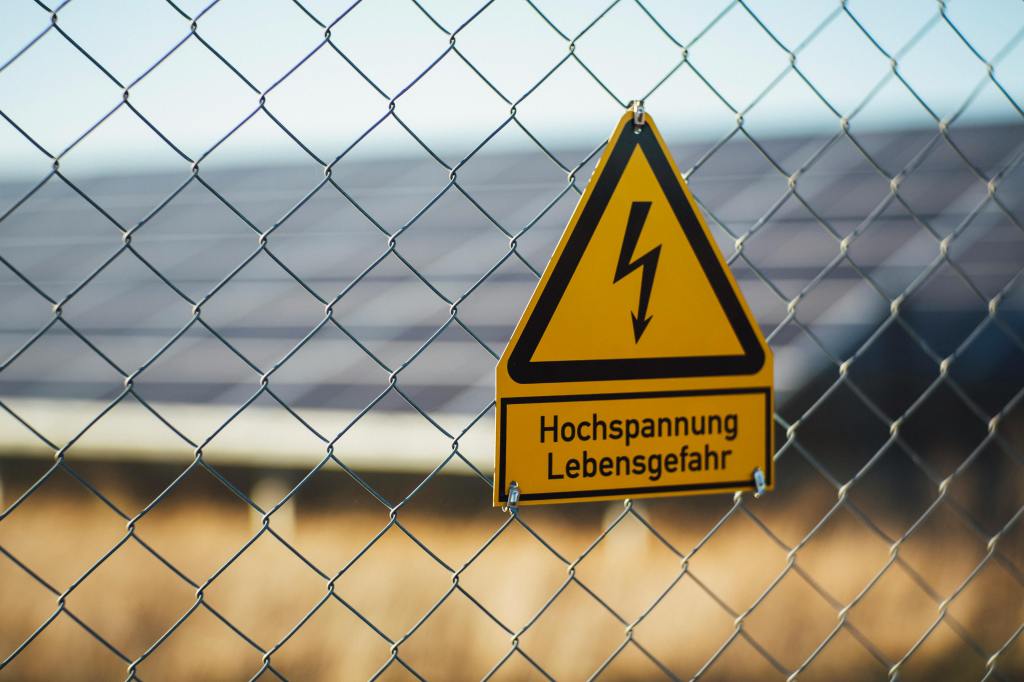
Devora would later confirm to me that this is initially where their mind went as well. They wrote: “I was observing the tangle of roots along my forest walks and even took the photos of my hands bound with sand to the metal fencing. As I continued to sit with the prompt, it occurred to me that something would be missing if I “simply” responded with such a gesture and then the image of what I ended up actually doing arose and, despite the sense of awkwardness and trepidation, I decided to follow that instinct.”
Because we are in different time zones, we often wake up to each other’s messages.
Early on the Sunday morning, I impatiently opened my email, unzipped the file, and clicked on the first video while my coffee was still brewing.
My first reaction was “what on Earth!”
What I saw in the video was a white pillowcase and duvet cover (although Devora would later insist they were beige), filled with something that seemed soft yet moderately heavy, being dragged along a gravel path through a green, leafy forest. The rhythmic sound of footsteps—”taka-taka-ta-ta-ka”—accompanied the soft scraping of the object on the ground—”shoo-shoo.”
I felt uncomfortable.
The perceived colour and shape of the object reminded me of a body wrapped in a mortuary shroud, a tradition common to many religions around the world. What wasn’t common of any of these traditions, and certainly not accepted, was the sight of the wrapped body being dragged along the ground, held by what would be the feet.
Devora shared that Izadora Reis, a chemistry post-doc student from Brazil, upon seeing the video artifact from this performance responded: “It’s strange but not wrong.”
I wanted to reply : “but it FEELS wrong!”
In most traditions, the bodies of the deceased are treated with reverence, and the ceremonies surrounding them are sacred. While many cultures eventually lay the body to rest in the earth, it is often elevated during mortuary processions. Being carried on people’s shoulders, something that is reserved for royalty while the body is still breathing, is accessible to everyone after death, regardless of status. One purpose of the mortuary cloth is to equalize social distinctions, regardless of one’s possessions or achievements in life. (Coffins and crypts don’t always serve the same function.)
However, not all shrouded bodies are eventually lowered into the ground. In some traditions, bodies are elevated even higher after the ceremony. Their return to the earth is not as immediate.
I realize that the expression I quoted in the last article, saying climate change can be “the nail in the coffin” for many Indigenous languages, was especially awkward, as many Indigenous cultures did not traditionally use coffins.
Differences in mortuary practices have often contributed to misunderstandings and judgments when cultures met. For example, European settlers were puzzled by some North American Indigenous traditions, such as burials in trees or on scaffolds. From the western perspective, the practice wasn’t as respectful as their “well-kept” cemeteries. But these traditions were indeed connected to the land on which the people lived: the Ponca for example would use scaffold because the ground was frozen, and the Lakota would not want animals to walk over or dig the bodies.
My gut interpretation of Devora’s gesture in response to “Bound to Earth,” which I initially thought would represent home, reminded me of something I read: “home is where your dead are’. At the time, I considered how cemeteries are immovable and often left behind, and how, in a new country, no tombstone bares your family name. Over time, a newcomer may transform into a local when they have a near-by place to honor their deceased. Actually, it is not uncommon for the first generation of immigrants to express the desire for their remains to be sent “back home” to rest with their ancestors. Is it only when you envision yourself staying somewhere beyond death that you truly start calling that place home?
But, interpreting that “home is where your dead are” with Devora’s performance and the thoughts they bring in mind, I suddenly dive into the realization that ancestral burial places go beyond cemeteries.
I think of a quote from Sharon Pollock’s Fair Liberty’s Call. (Pollock was a renowned Canadian playwright known for her work that explored historical and political themes, often focusing on injustice and human struggles. In Fair Liberty’s Call, set during the American Revolution, she examines the complexities of loyalty, rebellion, connection to the land, and integration with Indigenous peoples.) One of the characters utters: ““Your feet carry you back to the house but they leave no trace of your passing . . . This isn’t home. They aren’t our Dead.”
In many cultures, the dead are not always laid to rest in neat rows in landscaped cemeteries. Some burial places are less populated and less identifiable, unmarked – whether intentionally or by the passage of time. In some traditions, bodies are scattered in the form of ashes. Sky burials, such as those practiced in Tibet, involve placing a corpse on a mountaintop to decompose or be eaten by scavenging birds. The idea behind this practice is to return the remains to nature in the most “generous” way, giving it back to earth and everything on it.
When people speak of the “land of their ancestors,” they aren’t just referring to a burial place, but to the imagined space they call home. How many generations does it take for roots to truly take hold in a new place? When are there enough dead in this new land for the graft to truly take?
Back to Earth. I play the second video Devora sent.
It seems identical to the first. I try to detach myself from the meanings I transferred into these objects and see them what they are: a pillowcase and a duvet cover. The contents seem comfortable enough, and I can imagine one could lie on them, taking a moment to rest from walking. (After all, before the final rest, there are a few stops to make in this life!)
The gesture reminds me of nomadic people transporting their belongings behind them -on sleds or carts. Their homes, reduced to essentials, move with them, always ready for the next resting place.
My expectations for Devora’s response to “Bound to Earth” were shaped by my limited interpretation of what it means being connected to a place. My imagination fed me ideas of immobility and agricultural gestures.
Was I programmed to recognize these as codes of attachment to land? In school, we were taught about the progression of human societies: from hunter-gatherers to the agricultural revolution, then to the rise of cities, industrialization, and eventually the service economy. This narrative was framed as the natural evolution of “civilization”. I don’t recall learning that alternative lifestyles, like those of nomadic cultures, were possible, let alone compatible with the modern world.
Nomadic people aren’t displaced people. Everywhere they go is home. This concept is difficult to reconcile with Western legal systems, where land is typically viewed as a fixed asset, owned by individuals or entities with exclusive rights. Nomadic cultures tend to see land as communal and fluid. It doesn’t mean they lack a sense of ownership or belonging to the land. This misconception lies at the heart of many conflicts over the recognition of Indigenous land rights.
Nomadism traditionally developed in regions with harsh conditions, like steppes, tundra, or deserts, where mobility is the most efficient strategy for exploiting scarce resources. While few hunter-gatherers’ nomadic groups remain today, many pastoral nomadic groups continue to exist. Reindeer herders in the tundra, particularly in different regions of Russia, are semi-nomadic, following the seasonal forage for their animals. I was however once told that in today’s world their movement is also sometimes influenced by the availability of cellular networks. In some regions of the world, nomadic lifestyles remain relatively common. In Mongolia, about a quarter of households still live a nomadic way of life. Iran also has one of the largest nomadic populations in the world, with an estimated 1.5 million nomads out of a population of around 70 million. These groups are deeply connected to the land, and thus profoundly affected by climate change, which threatens their traditional way of life. A study of nomadic herders in the Western Himalayas noted that climate change is forcing earlier migrations, leading to challenges such as scarce pasture, avalanches, and livestock starvation, threatening their way of life.
In addition to nomads who travel with herds of livestock, there are itinerant groups that traditionally move for trade or work within sedentary populations. The Romani people in Europe are the most well-known, having made significant cultural impacts, often underrecognized. Other groups include the Woonwagenbewoners in the Netherlands, Voyageurs in Flanders, Skøyere or Fantefolk in Norway, and Pavee in Ireland. Many of these peoples maintain their own traditions and speak their own languages or dialects. They have long been both vilified and romanticized, seen as symbols of freedom and resistance to social norms – the local codes.
Nomadic or itinerant lifestyles are certainly more closely connected to nature than many sedentary ones, especially in urban settings. Therefore, Devora’s performance seems to be a fitting representation of being “bound to earth”, and also exposed to its elements. I can’t help but wonder what would happen to the sleeping gear they are carrying if it started to rain. It would quickly transform from a cozy mattress into a heavy, dirty mess.
In recent decades, a new group has appropriated the label of nomad: “digital nomads”. These are people who often lead often minimalist lifestyles: travelling with their laptops, smart phones, and few belongings. They live in temporary apartments or tourist accommodations, while working out of coworking spaces, cafes or beaches. While the term has been popularized in the early 1990s with the rise of computer networking and mobile devices, their numbers have surged since 2020. Notably, as remote work became more widespread, some countries have introduced special “digital nomad visas”. (The distinction between “remote work” and “work from home” is meaningful here.) However, I would imagine, their identities are closed to the ones of “expats” than of “nomads”.
Expats don’t carry their home with them, nor do they claim to be at home. Their identities remain tied to their home country, and they see themselves only temporarily somewhere because it’s profitable, interesting, or convenient. They might not bring their own pillowcase and duvet cover; instead, they occupy an apartment that comes with bedding or buy what they need cheaply nearby.
This lifestyle is enabled by technology, allowing digital nomads to travel light. No need to pack a heavy suitcase: everything needed for work is stored in the cloud, accessible anywhere. But clouds aren’t really clouds – data is stored in physical locations, well-grounded in various places across the planet. With the digitalization of our world and the expanding infrastructure required to support our more and more technology dependent lifestyle, the technosphere – the total mass of human-made objects – continues to grow. In 2016, it was estimated that its mass reached 30 trillion tons: more than 50 kilograms for every square meter of the Earth’s surface.
Here I must quote the Canadian journalist Andrew Nikiforuk:” Today technology and its material demands have colonized every biological zone on Earth and shape virtually all human life. By definition the technosphere represents an artificial (and parasitic) offshoot of the much-abused biosphere. It includes glass, concrete, asphalt and plastic, roaring furnaces and humming digital paraphernalia. It includes motors, missiles, the internet and all the energy humans wrangle to power them. AI has already penetrated just about every economic activity.”
Being a digital nomad or expat is a very different experience from those living traditional nomadic or itinerant lifestyles, but also from migrants or the displaced. Beyond their attachment to where they come from or the ability to return, the difference resides the welcome they receive in the new place they arrive.
However, all these people are connected by the invisible threads of humanity and its impact on the planet and each other. Borders are artificial lines drawn on maps, but while humans may cross them with varying ease depending on the colour of their passports, the issues they flee from are not confined to one place. Climate change might affect some populations or regions more than others at the moment, but its impact will reach everyone. Conflicts spill across borders. And as humans travel, voluntarily or not, they reshape every corner of the planet.
This brings me to a completely different interpretation of being “Bound to Earth” – in the sense that we are all bound to the Earth, this planet, this sphere suspended in space. We all share it. We all have the same home. And, for now at least, there’s nowhere else to go.

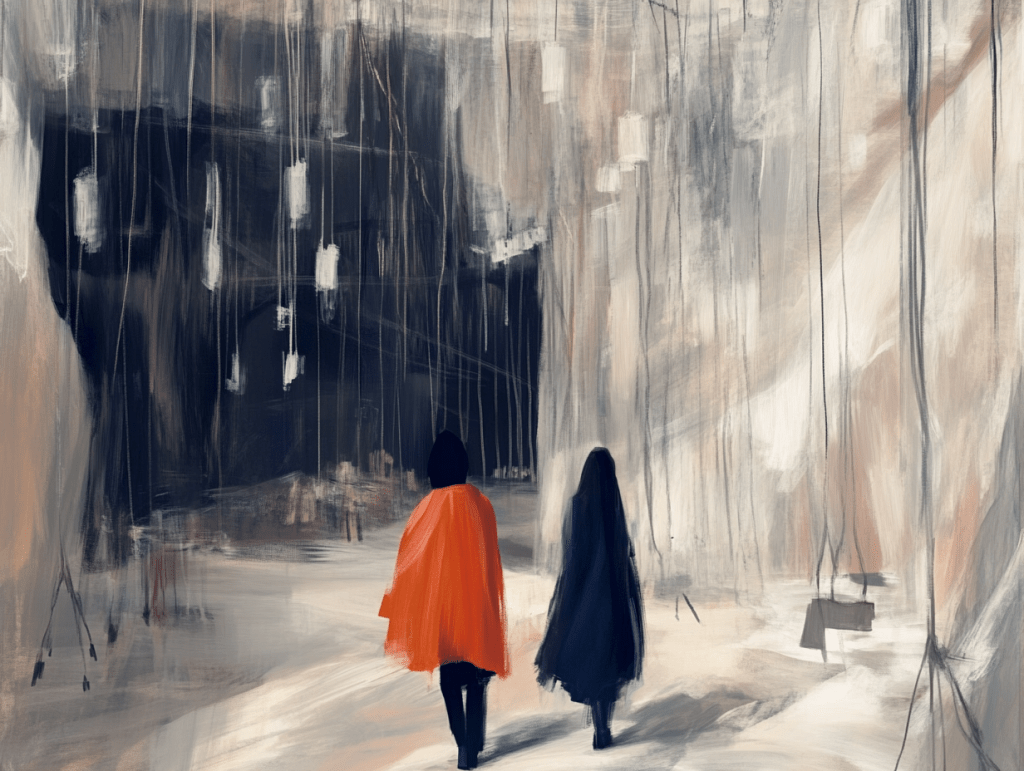
Generated with Midjourney, Prompt: “different meaning of codes, in the context of displacement, climate crisis and AI”My mind goes back to the comment, “It’s strange but not wrong.” After a week of reflecting on different aspects of this performance, I finally agree. The discomfort I felt was necessary to spark reflection, organize my thoughts, make connections, and emerge with a new perspective. I think I’m starting to understand a thing or two about this whole performance art process!


 Displacement Codes - Contemplative Performance and the Climate Crisis
Leave a comment